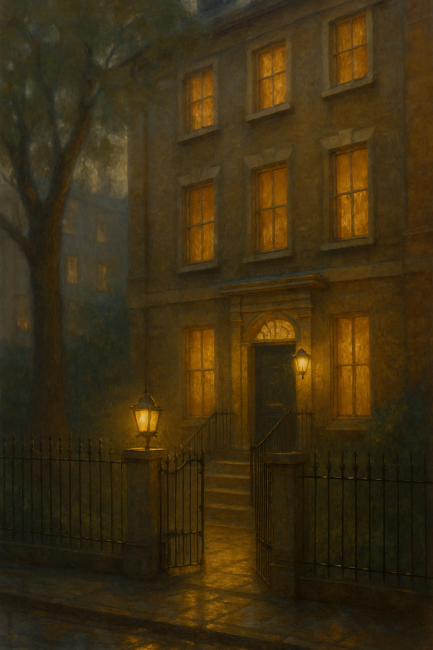
On a quiet London street, a three story Georgian townhouse holds its glow against the drizzle. Plane trees lean over the pavement and a wrought iron fence encloses a small courtyard where the gate sits a little ajar, as if the house itself has just taken a breath. Lamps throw amber light across wet stone. Milky glass and ornate ironwork frame the door. The façade bears old scars near the cornice, repaired long ago and left as a record of endurance.
Inside, the air is warm with beeswax and citrus. Marble floors are softened by old rugs and a dark oak staircase curves upward, its banister polished by generations. Family portraits share the walls with framed photographs, faces in oil and silver alike meeting you as if they have been expecting company. A gilt mirror keeps its quiet watch by the hall. The house makes small approving sounds as it settles, a home that has learned how to welcome.
Downstairs, the rooms hold to an old geometry. To the left, a sitting room arranges itself for conversation, chairs gathered around a low table where a book rests open and facedown. To the right, a short corridor leads to the kitchen, where sunlight pools on flagstones and a heavy wooden table carries a vase of late roses. Copper pans hang from a simple rack, their honest shine earned in work, and the stove ticks gently as it holds heat.
Behind the house a small walled garden keeps its privacy with ivy and roses and a weathered bench beneath a trellis. The city recedes here. The townhouse listens more than it speaks. There is a sense of boundary at the threshold, a quiet holding of the space, as if the walls remember their promises and intend to keep them.
It was Lilly’s, and now it is Lucy’s when London needs to be near. A place to arrive without ceremony, to gather, to rest, to plan the next step home.